
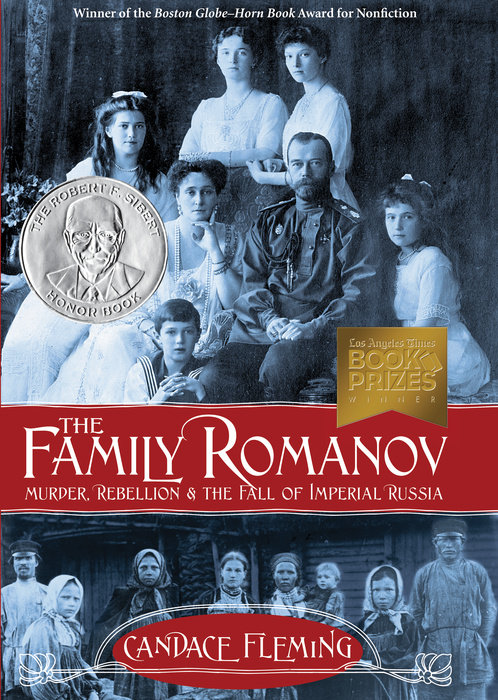
The Family Romanov: Murder, Rebellion, and the Fall of Imperial Russia


In this “superb history” (The Wall Street Journal), award-winning author Candace Fleming tells the extraordinary true story of Russia’s last royal family—and transports readers back to a time when both a bloodline and an empire came tumbling down.
“Has all the elements of a fictional thriller . . . woven into a fascinating work of history.”— The Washington Post
WINNER: Los Angeles Times Book Prize for Young Adult Literature and Boston Globe–Horn Book Award for Nonfiction • A Robert F. Sibert Honor Book • A YALSA Excellence in Nonfiction Award Finalist • A Kirkus Reviews Best Young Adult Book of the Century
He was Tsar Nicholas II of Russia: the wealthiest monarch in the world, who ruled over 130 million people and one-sixth of the earth’s land surface, yet turned a blind eye to the abject poverty of his subjects.
She was Empress Alexandra: stern, reclusive, and painfully shy, a deeply religious woman obsessed with the corrupt mystic Rasputin.
Their daughters were the Grand Duchess Olga, Tatiana, Marie, and Anastasia: completely isolated and immature girls who wore identical white dresses and often signed joint letters as OTMA, the initials of their first names.
Their only son was Tsarevich Alexei: youngest of the Romanovs, heir to the throne, a hemophiliac whose debilitating illness was kept secret from the rest of the world.
Candace Fleming deftly maneuvers between the plight of Russia’s poor masses and the extravagant lives of the Romanovs, from their opulent upbringings to the crumbling of their massive empire, and finally to their tragic murders. Using captivating photos and compelling first-person accounts throughout, The Family Romanov is history at its most absorbing.
An Excerpt fromThe Family Romanov: Murder, Rebellion, and the Fall of Imperial Russia
1881–1895
The Boy Who Would Be Tsar
On a frosty March day in 1881, the boy who would become Russia’s last ruler glimpsed his future. That morning, Nicholas’s grandfather, Tsar Alexander II, was riding through the streets of St. Petersburg when a man stepped off the sidewalk. He hurled a bomb at the imperial carriage. Miraculously, the tsar went uninjured, but many in his retinue were not as lucky. Concerned about his people, Alexander stepped from his carriage. That’s when a second bomb was thrown. This one landed between his feet. An explosion of fire and shrapnel tore away Alexander’s left leg, ripped open his abdomen, and mangled his face. Barely conscious, he managed one last command: “To the palace, to die there.”
Horrified members of the imperial family rushed to his side. Thirteen-year-old Nicholas, dressed in a blue sailor suit, followed a thick trail of dark blood up the white marble stairs to his grandfather’s study. There he found Alexander lying on a couch, one eye closed, the other staring blankly at the ceiling. Nicholas’s father, also named Alexander, was already in the room. “My father took me up to the bed,” Nicholas later recalled. “ ‘Papa,’ [my father] said, raising his voice, ‘your ray of sunshine is here.’ I saw the eyelashes tremble. . . . [Grandfather] moved a finger. He could not raise his hands, nor say what he wanted to, but he undoubtedly recognized me.” Deathly pale, Nicholas stood helplessly at the end of the bed as his beloved grandfather took his last breath.
“The emperor is dead,” announced the court physician.
Nicholas’s father--now the new tsar--clenched his fists. The Russian people would pay for this. Alexander II had been a reformer, the most liberal tsar in centuries. He’d freed the serfs (peasant slaves) and modernized the courts. But his murder convinced his son, Alexander III, that the people had been treated too softly. If order was to be maintained, they needed to “feel the whip.” And for the next thirteen years of his reign, Alexander III made sure they did.
Young Nicholas, standing beside his grandfather’s deathbed, knew nothing of politics. Frightened, he covered his face with his hands and sobbed bitterly. He was left, he later confessed, with a “presentiment--a secret conviction . . . that I am destined for terrible trials.”