The Saw Mouth
For fans of The Last Bookstore on Earth and Compound Fracture, a heart-pounding rural horror following a genderqueer teen who survives a near-apocalypse, only to be hunted by a mysterious monster whose very existence is entwined with their own.
From a breathtaking new voice in YA, this story is for anyone haunted by the sins of past generations—and fighting to right them.
When Cedar was a child, fragmented, tortured souls woke up in the world's most complex machines, destroying them and pushing technology back decades. A fall. The Fall, some said, and they called it Autumn.
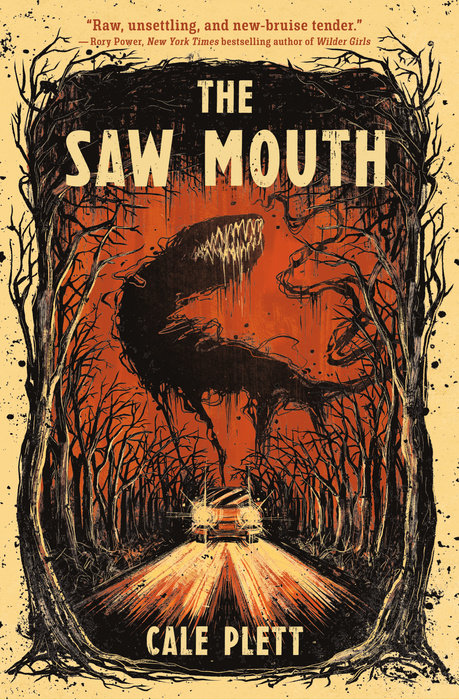
Ten years later, following a family tragedy, Cedar moves to the nowhere town of Sawblade Lake only to find something hunting them. A long, bent shadow that reeks like rot and has the mouth of a deep crevice. It's after Cedar, and it’s willing to go to any lengths to break them, including preying on Cedar’s new queer family.
The closer it circles, the more it seems to weave through Cedar’s whole life. It might stretch back to their mother’s gruesome, inexplicable death, to the murk of their missing family, to the house they grew up in. Back and back and back to the first day of Autumn.
Cedar thought they understood how their world had changed, but they’re far from dredging the bottom.
An Excerpt fromThe Saw Mouth
Chapter One
Three Weeks Earlier
Abraham’s Corner marks the first intersection of paved roads we’ve hit in an hour. I’ve been on a bus heading west on a secondary highway—a narrow slash through the wilderness. Just exposed rock, pine trees, and lake after lake. The late-June dusk has been settling around us as we go through the last stretch, so every time we pass another lake, the water seems a little blacker.
I haven’t seen a single indicator that the town I’m heading for even exists. I’m beginning to think maybe I’ll ride this bus to wherever the road runs out, but then the forest abruptly opens up enough for a gas station and an intersection. A wooden sign nailed to a tree tells me the name of this place in barely legible carved letters.
Abraham’s Corner.
The driver pulls onto the gravel in front of the gas station. The announcement system’s long dead, so he turns in his seat and calls, “All passengers for Sawblade Lake!”
Of the dozen people on the bus, I’m the only one to react. I grab my backpack and head down the aisle.
“Is this Sawblade Lake?” I’ve never been there, but I’m not seeing anything where we’ve stopped besides the small gas station and store.
“It’s as close as we get.” He sounds apologetic. I knew the person at the depot paused for too long before they sold me my ticket last night. The driver gestures out the front windshield to a signpost with sharp arrows. Two simply labeled North and East. The west one is for Fort something. And pointing south, Sawblade—34 Miles. “Not many people head that way anymore.”
I have to.
The bus recedes down the highway, leaving me alone in the parking lot in the humid air and dust. I imagine myself getting smaller and smaller in the rearview mirror. Tall, angular, wearing a black thrift store dress with a scattering of small flowers embroidered on it. No luggage besides my backpack slung over one shoulder. It’s enough. Even without the bag, I’m overburdened with what I can’t leave behind.
I slap a mosquito off my neck, leaving some specks of blood. A crushed body I flick to the ground. Part of me wants to see the bus’s brake lights come on. For it to turn around and for the driver to finish saying what he really meant.
Are you sure you want to go there?
There’s nothing else at Abraham’s Corner other than the twin streetlights at the crossroads. One’s lifeless, and the other flickers. The building itself sports chipped white paint, a pair of pumps, and a worn Coca-Cola sign. The promise of Bait N’ Tackle, cigarettes, video rentals. It’s not part of the old-tech comeback. Their VCRs are from the first time they were relevant, long before half of our complex machines found their voices and cried out. Before they burnt themselves down.
A fall.
The Fall, some said.
But calamity is mundane and repetitive. It wasn’t the end of the world, not even the world of humans, not even close.
Eventually, we started to simply call it Autumn.
The gas station is closed for the night, but at least there’s a pay phone. I’ve got a crumpled piece of paper I tore out of my mom’s address book before I left our basement apartment to the government agents in unmarked uniforms who were inspecting the scene. The paper has my grandma’s address and phone number, though I haven’t seen or spoken to her in the ten years since Autumn. I’d hoped to show up on her doorstep with the truth, that I had nowhere else to go.
It’s hard to turn away from the face of your family. I should know.
I walk over and lift the receiver to my ear. There’s nothing on the other end. No sound or response when I press the buttons. I should have guessed it wouldn’t be part of the new landline network. Hang it up, lift it again, hit more buttons.
That silence reminds me how far away I am from anything and anyone. It lodges in my chest.
I let the phone drop and bounce against the end of its cable like it’s been hanged.
Okay, okay, what next? I turn back to the parking lot. Sawblade Lake’s too far to walk. I don’t have to weigh the risks of hitchhiking because the only vehicles are occasional semis blasting by, always heading east or west, never down the dimming road to Sawblade. With trees coming right up to the pavement, it reminds me of a tunnel.
I don’t want to look at it, but it takes me a long time to tear my eyes away.
I can wait until the gas station opens and see if I can use their phone. It’s too many hours in my own head with my memories and the night. The last few days are blurry shards, like I saw them squinting through my fingers. Restless and tense just thinking about it, slap away another mosquito.
I glance down the road to Sawblade again. It’s like something that could swallow me whole.
So I sit around the side of the building in the corner made by the wall and a drink machine. From my backpack, my cassette player with dwindling batteries I’ve been saving. I’ve only got the tape I was listening to the last time I got home. It’s sad pop with sparkle, a high voice, the summer I thought I’d have.
Headphones on, press play. The hum of the drink machine against my back.
I settle in to try to last until morning.
I’m woken up by a small, short jangling noise. It’s bright and cheery, so for a second while I shift into wakefulness, I blearily think it must be dawn.
Instead, there are clouds over the moon and stars. The only thing pushing back against the night is the streetlight wavering on the edge of the parking lot, insects swarming around it. The air’s thick and heavy. Thunder not far off, nothing on the highway.
The scent hits me.
One moment I’m smelling old gasoline, pine needles, and fresh lake water—things I expect. Then, creeping in, something like marijuana smoke and rotting fall leaves, like blood and swamp water. Like it’s all at the bottom of a deep cave and I’ve just rolled away the stone and been hit with a blast of cold air that makes me shiver and leaves a taste in my mouth.
I’m awake like I’ll never rest again.
I realize my music isn’t playing anymore. I rewound it just before I finally fell asleep, so either the batteries died, or I hit the end of a side. I slip my headphones off and go to coil the cable around the cassette player, only to find it alive and popped open. It wouldn’t unlatch on its own. I check the tape. The side isn’t fully played. Like someone stepped near me in my sleep and reached down.
I stuff the cassette player deep into my bag.
I’m not thinking straight. It’s this choking smell. The dumpster’s wide open farther down the side of the building. It must be making the stench, though I didn’t notice it before, and I don’t think the dumpster was open. As I approach it, I tell myself the wind shifted. That some wild animal pushed the lid back.
Inside, there’s nothing but emptiness and the lingering odor of stale trash.
The bell on the gas station door.
That’s what I heard.
Someone opened the door.
It doesn’t seem quite right. We’re into the hours of the night where no one who’s up is up to anything good. Around the back of the building, just past the dumpster, I notice the door is also hanging open. Unlocked, not broken down. The smell persists as I approach it, keeping me on edge. The middle of nowhere filters my choices down. This could be a way to use the phone, either by asking whoever it is or hiding out inside. I step into the darkness.
I don’t hear anyone inside, and all the lights are off. I take slow steps into the main room of the gas station, where the only sound is the offbeat rhythm of water dripping into a bucket somewhere. The stench is worse here. Putrid, sweet. And all the drink-cooler doors are open, exhaling cold. I don’t see a phone either.
I step in something sticky and wet.
I stop dead. Pulse up, mind leaping to grotesque. Slowly, I look down. It’s just soda and energy drinks pouring out of open bottles and cans, which I can faintly make out scattered on the floor.
And then there’s a sound.
Lapping, bigger and slower than a dog. Like long, heavy movements of a huge tongue in the next aisle. Endless thirst.
The dark and smell and fear add up to suffocation, and I have to do something.
I grab a flashlight off the counter. Flick it on. Step forward and stumble over the bucket collecting water, sending it pouring across the floor, mixing with the drinks. Panic, slipping as I try to rise. The impossible crash of an entire aisle’s worth of shelves. A black space in front of me like a wave of oil. The front door is open.